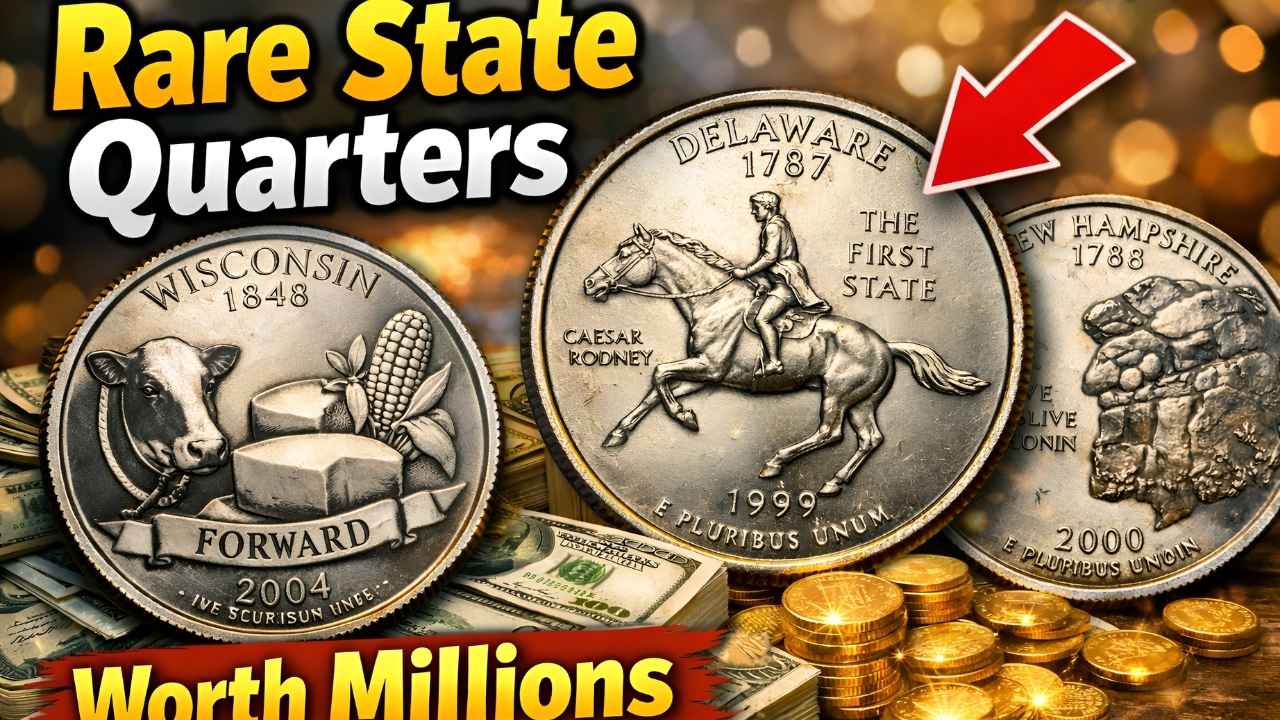
Rare State Quarters Worth Millions: When the United States Mint launched the 50 State Quarters Program, few anticipated it would ignite one of the most influential coin-collecting movements in modern American history. What began as a circulating commemorative series evolved into a treasure hunt for rare minting errors, low-mintage varieties, and historical oddities—some of which now command staggering prices at auction.
For collectors and investors alike, understanding which state quarters hold extraordinary value requires a close look at minting anomalies, production quirks, and hidden design variations.
Why State Quarters Became So Valuable
Between 1999 and 2008, the U.S. Mint released five new quarter designs each year, honoring every U.S. state in the order they ratified the Constitution. The program achieved:
- Over 34 billion coins minted
- Massive public participation in collecting
- Renewed interest in numismatics across generations
While most state quarters remain worth face value, rare errors and limited-production coins have reached values from thousands to, in exceptional circumstances, hundreds of thousands of dollars.
The Most Valuable Error Quarters
Certain minting errors dramatically increase a coin’s rarity and desirability.
1999 Delaware “Spitting Horse” Quarter
The Delaware quarter, featuring Caesar Rodney, became famous for a die crack that appears as a line extending from the horse’s mouth.

Why it matters:
- Early die-state error
- Easily identifiable visual anomaly
- Strong collector demand
High-grade examples can sell for several hundred to a few thousand dollars depending on condition.
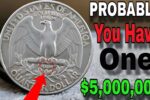
2004 Wisconsin Extra Leaf Quarter
The Wisconsin quarter is among the most famous state quarter errors ever discovered.
Two distinct varieties exist:
- Extra Leaf High
- Extra Leaf Low
These errors appear as additional corn leaves on the design. In pristine mint condition, these coins have sold for several thousand dollars, with rare specimens exceeding five figures at auction.
2005 Minnesota Doubled Die Quarter
The Minnesota quarter includes varieties featuring extra tree outlines due to die doubling.
Key features:
- Visible doubling in the forest area
- Multiple die varieties identified
- Strong interest among variety specialists
Top-graded specimens can command thousands depending on clarity and preservation.
2000 South Carolina Off-Center Strike
The South Carolina quarter has examples with dramatic off-center striking errors.
What makes it valuable:
- Significant misalignment during minting
- Percentage of off-center strike determines rarity
- High eye appeal for error collectors
Well-centered date visibility with strong displacement can dramatically increase value.
Silver Proofs and Special Editions
Not all valuable quarters are errors. Some derive value from composition and limited mintages.
The U.S. Mint produced:
- 90% silver proof quarters
- Special collector proof sets
- Limited presentation editions
Silver proof quarters, particularly in flawless PR70 condition graded by professional services, can reach strong premiums, especially when housed in original mint packaging.
Condition: The Ultimate Value Multiplier
The difference between a $20 coin and a $20,000 coin often comes down to condition.
Collectors look for:
- Mint State grades (MS65 and above)
- Proof grades (PR69 or PR70)
- Original luster and strike sharpness
- Absence of scratches, spotting, or discoloration
Professional grading by respected third-party services dramatically influences final sale price.
Hidden History Behind the Designs
Beyond monetary value, state quarters preserve rich historical narratives.
Each coin reflects:
- State heritage
- Cultural symbols
- Important historical figures
- Geographic landmarks
From colonial independence stories to frontier imagery, the program represents one of the most ambitious numismatic storytelling efforts in American history.
How to Identify Valuable State Quarters
To determine whether a state quarter may be valuable, examine:
- Mint mark location (P, D, or S)
- Design anomalies or doubling
- Die cracks or unusual raised lines
- Off-center strikes
- Silver edge coloration (solid silver stripe instead of copper core)
Using magnification tools and comparing coins to verified examples is essential.
Where Rare Quarters Sell for Big Money
High-value state quarters are commonly sold through:
- Major numismatic auctions
- Certified coin dealers
- Reputable online marketplaces
- Private collector networks
Auction results can vary widely depending on market demand and coin grade.
Are There Truly Million-Dollar State Quarters?
While headlines often claim state quarters are worth millions, confirmed multi-million-dollar sales are extraordinarily rare and typically tied to one-of-a-kind minting anomalies or unique transitional errors.
However, five-figure and occasional six-figure sales have occurred for exceptional examples in pristine condition or with highly unusual minting characteristics.
Final Thoughts for Collectors
The state quarter series remains one of the most accessible and exciting entry points into coin collecting. While most examples remain worth 25 cents, rare errors, top-condition specimens, and certified varieties can command astonishing premiums.
Success in this field requires patience, knowledge, and careful examination. For collectors willing to search through rolls, inherited jars, or old proof sets, the possibility of uncovering a hidden treasure remains very real.
In the world of numismatics, sometimes extraordinary value is hiding in plain sight—waiting to be discovered in everyday pocket change.